
Anti-cancer effect of camptothecin and chloroquine on the inhibition of lung cancer and breast cancer cell proliferation
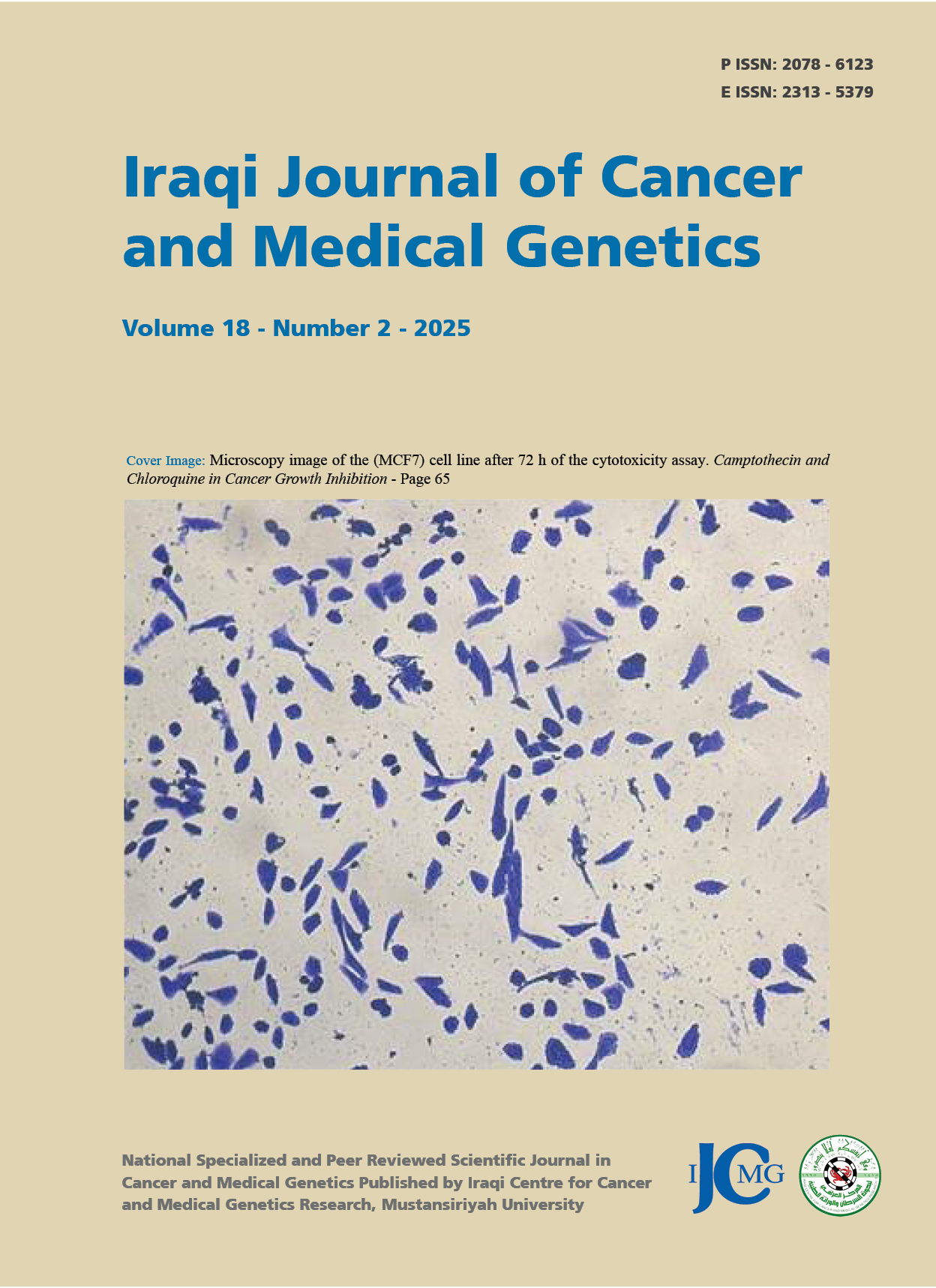
Camptothecin and Chloroquine in Cancer Growth Inhibition
DOI:
https://doi.org/10.29409/g6ayyc28Keywords:
camptothecin, chloroquine, lung cancer cell line(A 549), Breast cancer Cell line (MCF7).Abstract
Background:This research aimed to evaluate the toxic effects of chloroquine alone and in combination with camptothecin on two human cancer cell lines, namely, MCF-7 breast cancer cells and A549 lung cancer cells.
Objective: To determine the percentage inhibition of breast and lung cancer cells after 72 h of exposure to treatments utilizing (originally against C. trachomatis), chloroquine and camptothecin alone and in combination and to calculate the respective half-maximal inhibitory concentration (IC50) values. Methods: Exposure to varying amounts of chloroquine, camptothecin, and a mixture of these drugs was performed for 72 hours. The percentages of growth inhibition and IC₅₀ were obtained to investigate the cytotoxic effects. Results: Single treatment with chloroquine strongly reduced cell viability in both models; however, it moderately inhibited (57 - 63%) MCF-7 cells and strongly inhibited (72 - 77%) A549 cells, suggesting that lung cancer cells are more sensitive to chloroquine. Dual treatment with chloroquine and camptothecin resulted in dose-related cytotoxic activity. The inhibition was 17 - 35% at lower doses, whereas a greater percentage of cell death occurred (52 - 67%) at higher doses. Analysis using the IC₅₀ further confirmed the presence of an interaction between the two drugs. Conclusion: These findings indicate that chloroquine potentiates the antitumor effects of CPT, especially in A549 cells.
Author Declarations:
Acknowledgments
The authors sincerely thank the staff of the Iraqi Center for Cancer and Medical Genetics Research, Mustansiriyah University, Baghdad, Iraq, for their valuable technical assistance and laboratory support during this study.
Funding Statement
This research received no external funding.
Conflict of Interest Statement
The authors declare that they have no known competing financial interests or personal relationships that could have appeared to influence the work reported in this manuscript.
Ethics Statement
This study was conducted exclusively using established in vitro human cancer cell lines (MCF-7 and A549) obtained from the Cell Bank Unit of the Iraqi Center for Cancer and Medical Genetics Research, Mustansiriyah University. No human participants, patient samples, or live animals were involved. Therefore, formal ethical approval and informed consent were not required for this study.
Consent for Publication
Not applicable.
Data Availability Statement
The datasets generated and/or analyzed during the current study are available from the corresponding author upon rea-sonable request.
Author Contributions
All authors contributed equally to this work and have read and approved the final version of the manuscript.
Supplementary Materials
No supplementary materials are associated with this manuscript.
References
1. Mokhtari RB, Homayouni TS, Baluch N, Morgatskaya E, Kumar S, Das B, et al. Exploring the potential of combination therapy in the fight against cancer. Oncotarget. 2017;8(23):38022-43.
2. Blagosklonny MV. Enhancing the effectiveness of natural anticancer drugs through combination with artificial agents. Trends Pharmacol Sci. 2005;26(2):77-81.
3. Thai AA, Solomon BJ, Sequist LV, Gainor JF, Heist RS. Lung cancer. Lancet. 2021;398(10299):535-54.
4. Rebecca VW, Nicastri MC, Fennelly C, Chude CI, Barber-Rotenberg JS, Ronghe A, et al.
PPT1 promotes tumor growth and is the molecular target of chloroquine derivatives in cancer.Cancer Discovery. 2019;9(2):220–229.doi:10.1158/2159-8290.CD-18-0706
5. Koshkina N, Waldrep J, Knight V. Improved delivery systems of camptothecins for lung cancer treatment through aerosol. Curr Drug Targets. 2003;3(4):251-64.
6. Thomas A, Pommier Y.Targeting topoisomerase I in the era of precision medicine.
Clinical Cancer Research. 2019;25(22):6581–6589.
7. Zhang H, Wang X, Dai W, Gemeinhart RA, Zhang Q, Li T. Pharmacokinetics and treatment efficacy of camptothecin nanocrystals on lung metastasis. Mol Pharm. 2013;11(1):226-33.
8. Merritt JC, Friedman J, Perry HE, Colclough KW, Akers AT, Nolan N, et al. Capsaicin enhances the pro-apoptotic effects of camptothecin in small cell lung cancer. FASEB J. 2021;35(Suppl 1).
9. Kwong MS, Bleickardt E, Murren JR. Camptothecin and taxane regimens in small-cell lung cancer. Oncology (Williston Park). 2002;16(9 Suppl 9):33-8.
10. Su J, et al. Camptothecin-loaded and MnO2-coated polydopamine nanoparticles for MRI diagnosis and chemo-photothermal therapy of lung cancer. Int J Nanomedicine. 2022;17:6687-705.
11. Chiu YH, Hsu SH, Hsu HW, Huang KC, Liu W, Wu CY, et al. Modulating autophagy sensitises human non-small cell lung cancer cells to camptothecin. Int J Oncol. 2018;53(2):509-18.
12. Salimi-Jeda A, Ghabeshi S, Gol Mohammad pour Z, Jazaeri EO, Araiinejad M, Sheikholeslami F, et al. Autophagy modulation in cancer combination therapy: a promising approach. Cancer Treat Res Commun. 2022;30:100512.
13. Javaid HMA, Lim H, Shin S, Huh JY. Chloroquine inhibits autophagy and disrupts mitochondrial quality control in adipocytes. Arch Pharm Res. 2022;45(10):731-42.
14. Galluzzi L, Bravo-San Pedro JM, Levine B, Green DR, Kroemer G. Targeting autophagy in cancer. Cancer Discov. 2015;5(5).
15. Liu Y, et al. Pharmacology progresses and applications of chloroquine in cancer therapy.
International Journal of Nanomedicine. 2024;19:5859-5876.
16. Liu L, Han C, Yu H, Zhu W, Cui H, Zheng L, et al. Chloroquine hinders A549 lung cancer cell growth by impeding autophagy and inducing apoptosis. Oncol Rep. 2018;40(1):13-21.
17. Wang Y, Peng RQ, Li DD, Ding Y, Wu XQ, Zeng YX, et al. Chloroquine enhances the cytotoxicity of topotecan by inhibiting autophagy in lung cancer cells. Chin J Cancer. 2011;30(10):690-700.
18. Maycotte P, Aryal S, Cummings CT, Thorburn J, Morgan MJ, Thorburn A. Chloroquine sensitizes breast cancer cells to chemotherapy independent of autophagy. Autophagy. 2012;8(2):200-12.
19. Cook KL, Wärri A, Soto-Pantoja DR, Clarke PA, Cruz MI, Zwart A, et al. Chloroquine inhibits autophagy to potentiate antiestrogen responsiveness in ER+ breast cancer. Clin Cancer Res. 2014;20(12):3222-32.
20. Herbst RS, Morgensztern D, Boshoff C. The biology and management of non-small cell lung cancer. Nature. 2018;553:446–454.
21. Zappa C, Mousa SA. Non-small cell lung cancer: current treatment and future advances. Transl Lung Cancer Res. 2016;5(3):288–300.
22. Garnett MJ, Edelman EJ, Heidorn SJ, et al. Systematic identification of genomic markers of drug sensitivity in cancer cells. Nature. 2012;483:570–575.
23. Franken NAP, Rodermond HM, Stap J, Haveman J, van Bree C. Clonogenic assay of cells in vitro. Nat Protoc. 2006;1(5):2315–2319.
24. Mirzayans R, Andrais B, Murray D. Roles of the clonogenic assay in radiation and chemotherapy studies. Int J Mol Sci. 2017;18(11):2273.
25. Crowley LC, Christensen ME, Waterhouse NJ. Measuring survival of adherent cells with the colony-forming assay. Cold Spring Harb Protoc. 2016.
26. Pommier Y. DNA topoisomerase I inhibitors: chemistry, biology, and interfacial inhibition. Chem Rev. 2009;109(7):2894–2902.
27. Yu J, et al. High-content clonogenic survival drug screening identifies effective radiosensitizers in cancer cells. Front Immunol. 2025.
28. Zhang X, Zhang S, Liu Y, et al. Differential cytotoxicity of chemotherapeutic agents in lung versus breast cancer cell lines. Cancer Lett. 2019;454:1–10.
Additional Files
Received
Revised
Accepted
Published
Data Availability Statement
All data generated or analyzed during this study are included in this published article.
Issue
Section
License
Copyright (c) 2025 Iraqi Journal of Cancer and Medical Genetics

This work is licensed under a Creative Commons Attribution 4.0 International License.